The New Arms Race

We are very pleased to be cross posting this blog and sharing the work of Victor (Vittorio) Luca. It was originally published on his substack.
As of 5 February 2026 the only remaining nuclear arms treaty between the United States and Russia was allowed to expire by the Trump administration. The brakes on nuclear escalation are now off.
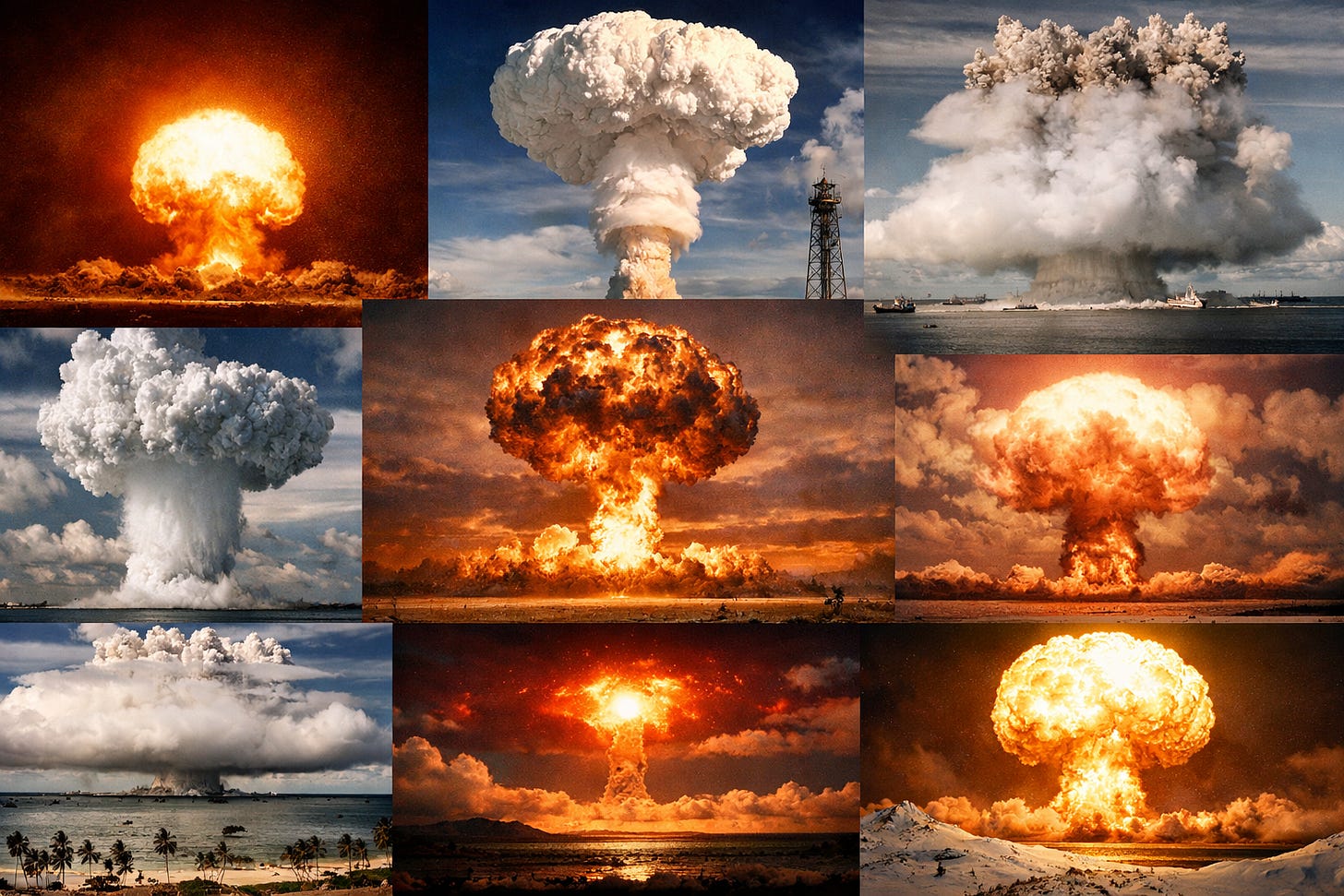
Montage of selected nuclear bomb tests.
The Cuban Missile Crisis of 1962, whose history I wont cover here, was a moment when the world narrowly escaped nuclear Armageddon. I had just been born and while it was a very close-call, it has not been the only close-call. There have been no less than 25 of these since the first atomic bombs were dropped on Hiroshima and Nagasaki. See the timeline of close-calls published by the Future of Life Institute.
The Cuban Missile Crisis was eventually resolved through cool- and level-headed diplomacy and the understanding and good-will between Nikita Khrushchev and John F. Kennedy. Nowadays, sadly, the traits possessed by Kennedy seem to be in very short supply.
Although the world dodged Armageddon in 1962, the cold war raged on for another three decades and in those days, unlike today, New Zealand was taking notice. And it is easy to understand why that was. The country had become particularly incensed by French nuclear testing in the South Pacific, New Zealand’s backyard. A total of about 193 nuclear tests were conducted (41 atmospheric, 152 underground) at Mururoa and Fangataufa atolls in French Polynesia between 1966 and 1996 and this was too close to home for even the usually apathetic New Zealand public to ignore.
The nuclear testing era of the 1980s was a period of frequent anti-nuclear marches in New Zealand and I joined my first ever protest march while at University in the capital, Wellington, in 1980. That particular march was to express public opposition to the entry of the nuclear war ship USS Truxtun (CGN-35) into Wellington Harbour. The Truxtun used nuclear propulsion and the US had a policy to ‘neither confirm nor deny’ the existence of nuclear weapons. New Zealand’s recalcitrance resulted in its expulsion from the ANZUS security treat in 1986. ANZUS is a collective security agreement between Australia, New Zealand, and the United States that was signed in 1951.
At the time I could never have imagined that a decade later I would end up a researcher in the field of nuclear science and technology.
From the time Enrico Fermi achieved the first controlled, self-sustaining nuclear fission chain reaction on 3 December 1942 to the dropping of the Hiroshima bomb only three years had elapsed. The US Manhattan project that developed the atomic bomb shows what a nation can achieve in a short space of time when the need is perceived to be existential. What a shame that today humanity can’t take the same approach today to preventing nuclear war or climate change.
What follows after the detonation of a nuclear bomb - either atomic bomb (fission) or hydrogen bomb (fission + fusion) - is a horrific sequence of events. A seismic shock wave, an electromagnetic pulse of gamma rays which ionizes the atoms in air molecules and a massive fireball followed by fire storms. And when that is all over there is the dust and radioactive fallout which comprises fission products and activation products (see here). For the interested reader a recent National Academies report of covers in detailed the potential environmental effects of nuclear war.
A graphic and terrifying account of what the immediate aftermath of a nuclear explosion looks like is given in the recent book by Annie Jacobsen, ‘Nuclear War. A Scenario’. The description given is based on interviews of many very high ranking nuclear scientists and military experts, and of course, the accumulated experience of the more than 2,000 real nuclear tests described previously and detailed studies of the aftermath of the Hiroshima and Nagasaki bombings. For the interested reader, I reproduce the forward to Jacobsen’s book in Appendix 1.
For those less inclined to reading I can recommend the following YouTube video by the Future of Life Institute gives a taste of the matter:
How would a nuclear war between Russia and the US affect you personally?This video has been viewed 4.8M times since it was first posted.
By coupling real experiences with theoretical physics, scientists have gotten very good at simulating the effects of nuclear detonations such that there is virtually no longer a need for physical testing. Not at least from a technical point of view. Simulations of full-scale nuclear war have also gotten very good. The reader is referred to this video for a version of how it may play out.
Regrettably, by my estimation, the risks of nuclear war have never been as great as they are today. We are once again on the precipice but this time the nuclear threat is being met by relative insouciance. The topic of nuclear war is barely discussed in the shops, cafes and supermarkets as it was in the 1980s.
Fast forward to present, when on the 27th of January the famous Doomsday Clock (Bulletin of Atomic Scientists) was advanced four seconds from 89 to 85 seconds to midnight (see here). This is the closest the clock has ever been to midnight.
For decades following the bombings in Japan, until the end of the cold war in 1991, the buildup of nuclear weapons had been dramatic. Then the Strategic Arms Reduction Treaty (START I) was signed by the United States and the Soviet Union (31 July 1991). Many more such arms reduction treaties were to follow.
On 2 August 2019 the Intermediate Nuclear Forces (INF), which banned all nuclear and conventional ground-launched ballistic and cruise missiles with ranges of between 500 and 5,500 km, collapsed when the Trump administration withdrew from the agreement (see here). A new ‘Nuclear Posture Review’ was published in 2018 and envisaged a greater number of new generation weapons. Other treaties have also fallen by the wayside.
On 5 February 2026 the only remaining nuclear arms treaty between the United States and Russia expired. The Russians indicated their willingness to extend the treaty but tragically the Americans have refused.
Dmitry Medvedev posted the following on X (Twitter):
‘That’s it. For the first time since 1972, Russia (the former USSR) and the US have no treaty limiting strategic nuclear forces. SALT 1, SALT 2, START I, START II, SORT, New START - all in the past.’
Medvedev has served as deputy chairman of the Security Council of Russia since 2020. He was also President of Russia from 2008 to 2012 and Prime Minister of Russia from 2012 to 2020.
The NEW START treaty imposed limits on deployed strategic weapons. More specifically, the following limits applied:
- 700 deployed intercontinental ballistic missiles (ICBMs), deployed submarine-launched ballistic missiles (SLBMs), and deployed heavy bombers equipped for nuclear armaments.
- 1,550 nuclear warheads on deployed ICBMs, deployed SLBMs, and deployed heavy bombers equipped for nuclear armaments (each such heavy bomber is counted as one warhead toward this limit).
- 800 deployed and non-deployed ICBM launchers, SLBM launchers, and heavy bombers equipped for nuclear armaments.
Although NEW START limited the number of nuclear warheads, even that limited number would be more than enough to guarantee the death of untold people, serious climate disruption, environmental and ecosystem destruction and widespread contamination of the biosphere.
The refusal by the US to extend the treaty is tantamount to a clear declaration that America will abide by no rules and that it will stop at nothing to maintain world hegemony. For those unlucky enough to survive a nuclear holocaust it is debatable if life would be worth living. Considering what is at stake, would it not better to have some limitations than none?
Recent studies have suggested that a war between India and Pakistan would result in the death of more than two billion people, while a war between the US and Russia could result in the death of five billion (Xia et al., 2022). Whether a limited nuclear war is possible without escalating to include all nuclear armed states is a subject of debate. I tend to think that limited nuclear war is an impossibility.
Today there are eight declared nuclear weapons states. Although Israel has never declared, it is safe to assume that they are nuclear armed.
The case has recently been made by retired MIT Professor, Theodore Postol, that Iran is either an undeclared nuclear weapons state or it is a threshold state meaning that it is not far from putting together a relatively simple bomb (see here).
Although Trump declared that Iran’s nuclear capability had been ‘obliterated’, during a US-led bombing campaign of Iranian nuclear sites in June of 2025 that was unapproved by the US congress, no proof has ever been provided that the 400 kg of 60% enriched uranium that the Iranians had generated to date had been recovered.
Moving from 60% to 90% enriched uranium (weapons grade) is relatively straight forward with a relatively small centrifuge cascade. The question I find myself asking is if there are already nine weapons states, why should the sovereign and civilizational state of Iran not have the right to develop nuclear weapons if it feels it needs a nuclear deterrence capability?
That said, Iran’s Supreme Leader, Ayatollah Ali Khamenei, has maintained a long-standing, publicly declared fatwa (religious decree) since the early 2000s that forbids the production, stockpiling, and use of nuclear weapons, calling them “haram” (forbidden) in Islam. Wouldn’t it be great if all other nuclear states would follow that example.
The global stockpile of nuclear weapons is dominated by Russia and the US and what they currently hold is truly terrifying. The current stockpile however pales in comparison to what it used to be before limits were agreed to.
As nuclear arms treaties are dissolved, the world sleeps on.
One aspect of the nuclear threat that folk pay relatively little attention to is that of a conventional weapon attack on nuclear power plants of which there are currently around 440 connected to electricity grids around the world. I wrote about this in the context of the Ukraine war and a potential attack on the Zaporizhzhia nuclear power plant by either of the warring parties or third parties (see Nuclear power, nuclear war and Ukraine).
There are an additional 220 - 230 nuclear research reactors dotted around the planet also. These research reactors can range in size from kilowatts to megawatts (typically from 5 - 30 MW) and are most often used for the production of isotopes for nuclear medicine and for materials science research. The neutron beams produced by the reactors are used for interrogating the structure and properties of a wide range of materials.
Although research reactors are usually small relative to power reactors there is none-the-less enough nuclear material in their cores, which if struck by a conventional explosive could breach the containment, resulting in the dispersal of significant amounts of radioactive material. Depending on specific factors including weather conditions the fallout could cover a very wide area and would significantly impact the lives of millions. Spent fuel storage pools are another vulnerability. I know from experience that the containment shield of the Australian Opal reactor was only designed to withstand the impact from a light aircraft and not a missile. The release of significant amounts of 137Cs, 90Sr and 131I and other fission and activation products over a wide region would be a real possibility if the reactor were struck by a conventional weapon.
Whilst it is hard to precisely predict what would happen were a research or power reactor struck by a missile carrying a conventional warhead, a potentially appropriate model might be Chernobyl in Ukraine in April of 1986. In that case the RBMK reactor blew up during safety testing not through the impact of a conventional explosive. The Chernobyl reactor had no containment shield and so radioactivity was dispersed over a very wide area. The current Chernobyl exclusion zone is 2,600 km2.
Referring to the current global hotspot in the Middle East, I note that Israel has two research reactors at the Soreq Nuclear Research Center in Yavne and the Negev Nuclear Research Center near Dimona. Iran has one operating power reactor and four small research reactors. The UAE has four operating power reactors at the Barakah nuclear power plant in Abu Dhabi.
Considering that the metro area of Tel Aviv is 1,500 km2 and is home to four million people, a deliberate or accidental conventional missile strike on its research reactor could be messy indeed. Similar conclusions could be reached in the case of Iran.
Although serious, a conventional missile strike on a nuclear reactor would pale in comparison to the detonation of a strategic nuclear weapon in a city, it would none-the-less have extremely serious consequences.
Coming back to the possibility of all-out nuclear war. It is debatable whether a limited exchange of strategic weapons is even possible since escalation would seem almost inevitable. Thus, we must force ourselves to think about the unthinkable and prepare and do our utmost to prevent the folly.
My experience in New Zealand local government circles, or what I have observed in central government, or in ordinary life these days, is that little or nothing is being done on the individual or collective level to consider options. What I can say is that currently New Zealand’s National Risks Register contains no entry for nuclear war. The national risks that feature in the register include all of the usual suspects including earth quakes, volcanic activity, severe weather and flooding, Tsunami, drought and space weather, disease outbreaks and so on. The closest the register comes to anything nuclear is reference to a radiological substance incident. This I image refers to a possible release of medical isotopes, including 99Mo/99mTc isotope generators and sealed sources which would be relatively trivial incidents.
I have been involved in New Zealand local government for six years and have mentioned the risks of nuclear war many times and what might be done both to avert and deal with the aftermath should humanity be stupid enough to take us to hell. All I have ever met with are incredulous stares and dismissive responses. I suspect that one of the reasons for the resistance to think about the risks of nuclear war these days is that despite many close calls, for 80 or so years nothing has actually happened. This could lull folk into a false sense of security.
It would be false to conclude that the reason for the lack of concern is because of the belief that mutual deterrence strategy operating on the principle of Mutually Assured Destruction (MAD) is working.
New Zealand had its nuclear moment and now we can sweep it all under the carpet. The sense of geographic remoteness further serves to engender that false sense of security. Another pervasive view in New Zealand seems to be that nuclear war will likely occur somewhere in the northern hemisphere and would have little impact on what is one of the most geographically isolated nations on the planet. This sort of thinking has enabled many to incorrectly conclude that the risks are infinitesimally small.
And yet the Doomsday clock has never been closer to midnight than it is today.
Institutions such as the Cambridge University’s Centre for the Study of Existential Risk (CSER) give due regard to the possibility of nuclear war. However, CSER does not stipulate a particular order for these catastrophic existential risks, I have attempted a prioritization in Table 1 in terms of likelihood and impact whilst acknowledging that classifying and assigning the consequence and likelihood components of risk is complex and highly uncertain and potentially of limited utility. Nevertheless, expert opinion as at 2021 estimates the probability of nuclear catastrophe by 2045 to be somewhere between 1 and 5% (see here). This is not what you would call negligible.
That estimate of probability was in 2021. I would argue that the current geopolitical terrain has become considerably more hostile in recent years driven by a significant increase in great power rivalry. Two areas of heightened tension and conflict are the Ukraine proxy war and the Middle East and the brewing tensions between China and the US. I will not elaborate further on these here, except to say that these are primary drivers of risk.
the US. I will not elaborate further on these here, except to say that these are primary drivers of risk.
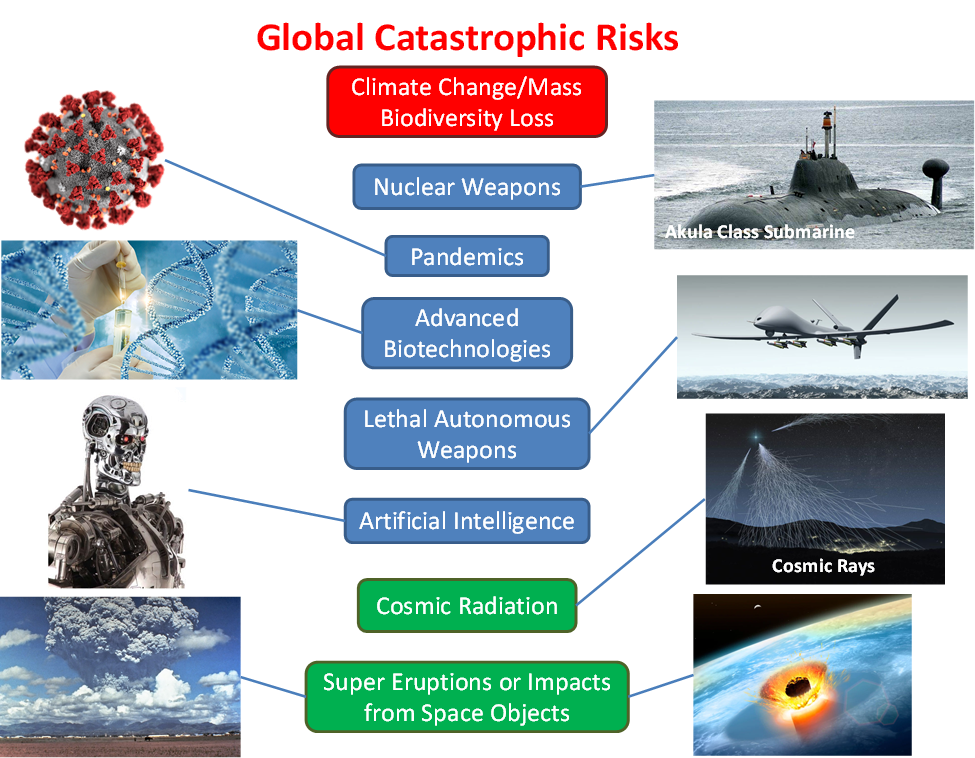
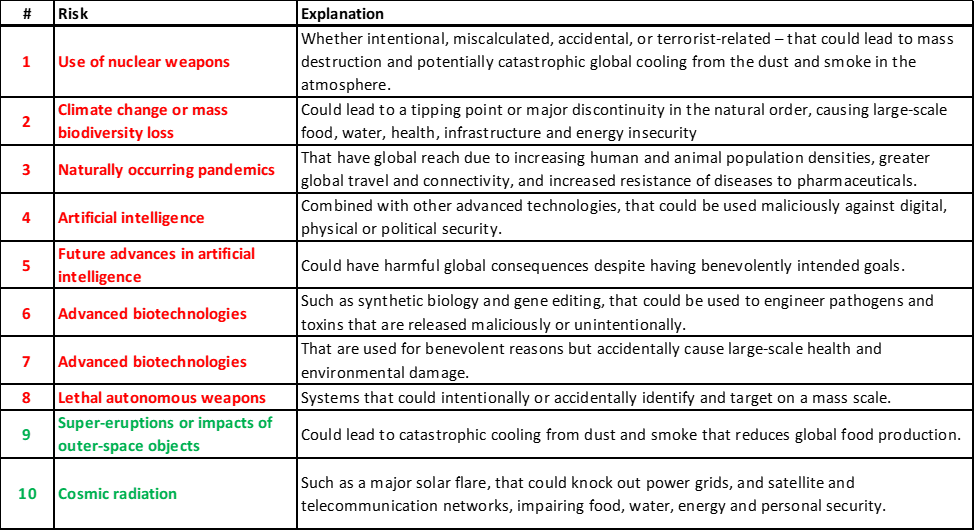
Most of the catastrophic risks in Table 1 are endogenous in the sense that they are entirely dependent on human actions (red). Others are exogenous (green) in that there is little or nothing humans can do to avert the risk (supervolcanoes, huge Earth quakes or cosmic radiation). Endogenous risks such as nuclear war, climate change, artificial intelligence and naturally occurring pandemics depend entirely on human decisions and actions. That is, they are endogenous or generated within human systems. Although Rand Corporation’s Global Catastrophic Risk Assessment report was issued in 2024, for some reason it appears to have been withdrawn. (https://www.rand.org/pubs/research_reports/RRA2981-1.html) Nevertheless, the report has been discussed by others (Boyd and Wilson, 2025).
If the non-negligible probability of full-scale nuclear war is admitted, then asking the next question of how to respond is something that has generated little or no civic discourse in New Zealand. And yet the UN is currently convening an independent scientific panel on the effects of nuclear war.
Considering the likelihood and consequences of nuclear war, especially in the present era of heightened global conflict, it is particularly perplexing how the New Zealand government has taken little or no action to educate the public or to take action on the global stage or the stage of international relations or foreign policy with a view to averting disaster; not even feeble attempts. In my capacity as a district mayor I wrote to the Prime Minister in August of 2024 to ask that he do everything in his power to avert nuclear war. I was not expecting miracles or even a response, and indeed no response was ever received.
In New Zealand today we have a civil defense system that is based on the so-called four Rs; Reduction, Readiness, Response, and Recovery. There is no mention in any of the documentation of an anticipatory function, especially in regards to nuclear war. That is, the question is not even asked about what happens if the unthinkable happens.
In the case of nuclear war, what is sadly lacking is a failure to move from disaster response to anticipation and readiness. The issue is simply treated as non-issue because presumably the risks are considered minuscule, or perhaps there is a sense of helplessness. In nuclear war planning, if anything is being done at all, then Government is keeping it secret despite the imminent threat admitted by the Bulletin of Atomic scientists that are responsible for the Doomsday Clock. The public is kept out of the loop and instead fed a diet of sports and trivia.
The granting of New Zealand citizenship to tech billionaire Peter Thiel in 2011, despite having only spent 12 days in the country, is interesting because it made headlines and especially because his motivations for wanting citizenship included securing a ‘safe haven’ or ‘bolt-hole’ or ‘apocalypse insurance’ in a remote location and aligning with a country he viewed as ideal for the future. Thiel is part of what has become known by the derogatory term as the Paypal Mafia. Thiel was looking for somewhere to escape to when you-know-what hits the fan. At least to Thiel therefore, the threat of nuclear war is considered real.
In contrast to the absence of discourse in public or government domains, some New Zealand academics are doing excellent work in this area. Boyd and Wilson (Boyd and Wilson, 2023) recently published a paper in the academic journal Risk Analysis entitled ‘Island refuges for surviving nuclear winter and other abrupt sunlight – reducing catastrophes’. The paper considers the ability of small island nations such as New Zealand to survive abrupt Sunlight Reduction Scenarios (ASRS) such as nuclear winter and its ability to help reboot-collapsed human civilization. This is not a minor thought experiment, not least because of the extreme inter-connectedness of supply chains that has remained largely unappreciated by governments and the public at large until relatively recently. I have attempted to help call attention to this in my recent post ‘Living in a Materials World’.
The work by the two New Zealand academics is becoming increasingly important as geopolitical tensions escalate and the build-up for war progresses. The US as a major aggressor nation is currently undergoing a significant, rapid and policy-driven revitalization of its nuclear arsenal. The renaming of the Department of Defense to the Department of War is more than just a symbolic gesture and the commitment to increasing the military budget from an already astronomical $1T per year to an absolutely absurd $1.5T is worrying. Threatening overtures towards China over the past decade have also forced China to increase its deterrence capability.
To top it all off, the first Trump administration dissolved the Joint Comprehensive Plan of Action (JCPOA) that limited Iran’s nuclear development and is turning its back on arms reduction treaties that required a huge effort to put in place.
The current military build-up in the Persian Gulf is an extremely worrying current development with significant US military assets moving into area, an action clearly designed to provoke regime change in Iran. The Iranians have stated emphatically that any attack by the US and/or Israel will be met with a swift no-holds-barred response. They have stated that they will strike Israel and many of the large number of US military bases in the region. Today with the advanced missiles that Iran possess, sinking an air-craft carrier would be relatively easily achievable. Were this to happen, a nuclear response would not be out of the question.
As tensions mount in the Perisan Gulf, Iran will be holding joint naval drills (Maritime Security Belt) with China and Russia in the northern Indian Ocean region (see here). The planning and programming of these drills predates current episode of hostilities. Both Russia and China have significant strategic interests in supporting Iran given that they are all BRICS nations.
Iran is a civilizational state that is a significant oil producer and represents the door to the caucuses. Moreover, the closure of Strait of Hormuz has been threatened by Iran and this would have significant ramifications for the world energy system. The impact on New Zealand should not be underestimated since the country is not self-sufficient in liquid fuels. New Zealand generates about 20 million barrels of oil per year and consumes 47 million barrels. No oil is refined in the country. Imagine what would happen if there is no diesel fuel in a country where almost all goods are transported by diesel trucks.
Aside from direct military confrontations, also ongoing are what might be considered trade and resource or commodity wars. These can provoke or exacerbate existing military conflicts.
I would go so far as to say that WWIII is already simmering and it would take little to bring matters to the boil. It is long past time to turn down the heat.
The world is fast becoming an increasingly dangerous place. Today more than ever there is a need for serious diplomacy and good-faith negotiation. Where are the JFKs when we need them?
References
Avin, S., Wintle, B.C., Weitzdörfer, J., Ó hÉigeartaigh, S.S., Sutherland, W.J. Rees, M.J. Classifying global catastrophic risks. Futures 2018, 102, 20-26
Bivens, M. Nuclear Famine - International Physicians for the Prevention of Nuclear War. 2022.
Boyd, M., Wilson, N. Island refuges for surviving nuclear winter and other abrupt sunlight – reducing catastrophes. Risk Analysis. 2023, 43, 1824–1842.
Boyd, M. and Wilson, N. Global Catastrophe Assessment: What RAND’s Landmark Report Tells Us About Civilisation’s Biggest Threats. 12 November 2024.
Boyd, M. and Wilson, N. From disaster response to anticipatory governance. Policy Quarterly 2025, 4, 61. DOI: https://doi.org/10.26686/pq.v21i4.10337
Burr, W. Cold War estimates of deaths in nuclear conflict. Bulletin of the Atomic Scientists, 4 January 2023.
Catalinac, A.L. Why New Zealand Took Itself out of ANZUS: Observing ‘‘Opposition for Autonomy’’ in Asymmetric Alliances. Foreign Policy Analysis 2010, 6, 317
González, A.J. Irretrievability of high level waste and spent nuclear fuel. 1999, IAEA TECDOC-1187.
Guardian, Grave moment’: end of US-Russia nuclear pact comes at worst possible time, UN chief warns. 5 February 2026.
Hellman, M.E. and Cerf, V.G. An existential discussion: What is the probability of nuclear war? 18 March 2021.
ICAN (International Campaign to Abolish Nuclear Weapons), The expiration of New START: what it means and what’s next. 4 February 2026.
Kaur, S. One nuclear-armed Poseidon torpedo could decimate a coastal city. Russia wants 30 of them. Bulletin of the Atomic Scientists. 14 June 2023.
Luca, V. Nuclear power, nuclear war and Ukraine. 9-May-22
Miller, S. Treaties to limit the proliferation of nuclear weapons are failing. The Guardian. 8 February 2026. Miller suggests that there are diplomatic and practical steps that could make us all much safer.
National Academies of Science, Engineering and Medicine. Potential Environmental Effects of Nuclear War. 2025, Washington, DC: National Academies Press.
https://doi.org/10.17226/27515.
Pravalie, R. Nuclear Weapons Tests and Environmental Consequences: A Global Perspective. Ambio 2014, 43, 729.
Simon, S., Bouville, A., Land, C. Fallout from Nuclear Weapons Tests and Cancer Risks. American Scientists 2006, 94(1), 48.
Wilson, N. Kerr, J. Boyd, M. New government document on hazards: Good progress but gaps remain. The Briefing, 21 August 2025.
Xia, L., Robock, A., Scherrer, K. et al. Global food insecurity and famine from reduced crop, marine fishery and livestock production due to climate disruption from nuclear war soot injection. Nat Food 2002, 3, 586-596. https://doi.org/10.1038/s43016-022-00573-0
Useful Links
This is a link to Matt Boyd’s website which is an excellent resource on matters of global catastrophic risks. Matt is the founder and research director of Adapt Research (est. 2015), where he leads independent, evidence-based work at the intersection of public health, technology, policy, and global catastrophic risk.